Quick answer: No, YouTube doesn’t send you a W-2 — and neither do the brands you work with. As a creator, you’re not an employee of Google, a sponsor, or a platform. You’re an independent business, and the tax forms you receive (or don’t receive) reflect that. Instead of a W-2 with tax already withheld, you get 1099s that simply report what you were paid — with nothing taken out and no one else handling your tax bill.
That difference is bigger than a form number. It changes who owes what, when it’s due, and what you’re allowed to deduct.
Why YouTubers Never Get a W-2
A W-2 only exists where there’s an employer-employee relationship. The IRS decides whether that relationship exists using a common-law test built around three questions:
- Behavioral control — Does the payer control how you do the work? A brand sponsoring your video tells you what to mention and what not to say, but they don’t dictate your editing software, your filming schedule, or your creative process the way an employer directs an employee.
- Financial control — Do you bear the business risk? You bought your own camera. You pay for your own editing software. You don’t get paid if you don’t publish. That’s a business owner’s risk profile, not an employee’s.
- Relationship type — Is there a contract implying an ongoing employment relationship, or benefits like health insurance and paid vacation? Sponsorship and ad-revenue arrangements are project-based and non-exclusive — the opposite of what defines employment.
Weigh those three together for a typical YouTuber, and the answer is consistently the same: you’re running an independent business that brands and platforms pay for a service, not an employee on anyone’s payroll. That makes you an independent contractor, and independent contractors get 1099s, not W-2s.
Source: IRS — Independent Contractor (Self-Employed) or Employee?
What a 1099-NEC Actually Means (and When You’ll Get One)
Form 1099-NEC (“Nonemployee Compensation”) is how a business reports that it paid an independent contractor. For 2026, most payers issue one once they’ve paid you $2,000 or more in a calendar year — up from the long-standing $600 threshold, which changed under recent federal legislation. Some platforms, including Google, hadn’t updated their published guidance to the new number as of this writing, so don’t be surprised if you see $600 referenced in places. Either way, the threshold is per payer, not a total across all your income — a sponsor who paid you $1,500 and another who paid you $1,800 might each stay under the threshold and neither would send you a form, even though you received $3,300 combined.
A 1099-NEC is purely informational. It doesn’t calculate anything for you, and receiving one — or not — has zero bearing on whether the income is taxable. It’s simply the payer telling the IRS (and you) what they paid.
The Big Implication: Nothing Is Withheld — It’s All on You
This is the part that catches new creators off guard. A W-2 employee’s employer automatically withholds federal income tax, Social Security, and Medicare from every paycheck, and pays half of the Social Security and Medicare bill (7.65%) out of its own pocket on top of your wages. When a brand or platform pays you as a 1099 contractor, none of that happens. You’re paid the full amount, in full, with nothing withheld — which means the entire tax bill, both halves of the payroll tax and your income tax, becomes your responsibility to calculate and pay yourself.
Here’s what that hidden cost actually looks like: if you earned $50,000 in W-2 wages, your employer would separately pay around $3,825 (7.65%) in matching payroll tax on your behalf — money that never touches your paycheck and that you’d probably never think about. Earn that same $50,000 as a 1099 creator, and there’s no employer to absorb that cost. It becomes part of your 15.3% self-employment tax bill instead. Nothing was taken from you before — it’s just newly visible.
Because there’s no automatic withholding, most creators need to pay quarterly estimated taxes throughout the year rather than settling up once in April. For the deadlines and how to calculate your payments, see Quarterly Estimated Taxes for YouTubers →.
W-2 Employee vs. 1099 Creator: Side-by-Side
| W-2 Employee | 1099 Creator | |
|---|---|---|
| Tax withholding | Employer withholds income tax, Social Security, Medicare from each paycheck | Nothing withheld — you calculate and pay it yourself |
| Payroll tax (15.3%) | Split with employer — you pay 7.65%, employer pays 7.65% | You pay the full 15.3% yourself |
| Benefits | May include health insurance, retirement matching, paid leave, unemployment insurance | None — you fund all of it yourself |
| Business expense deductions | Generally none — unreimbursed job expenses are permanently non-deductible as of recent tax law | Deduct any ordinary, necessary business expense (gear, software, home office, contractors, and more) |
| Tax form received | W-2, showing wages and taxes already withheld | 1099-NEC (and sometimes 1099-K) from each payer who crosses the threshold |
| Tax forms filed | Simple 1040, often no additional schedules needed | 1040 plus Schedule C and Schedule SE |
| Control over work | Employer sets hours, methods, and tools | You set your own schedule, equipment, and creative process |
| Income stability | Regular paycheck regardless of performance | Income tied directly to views, deals, and output |
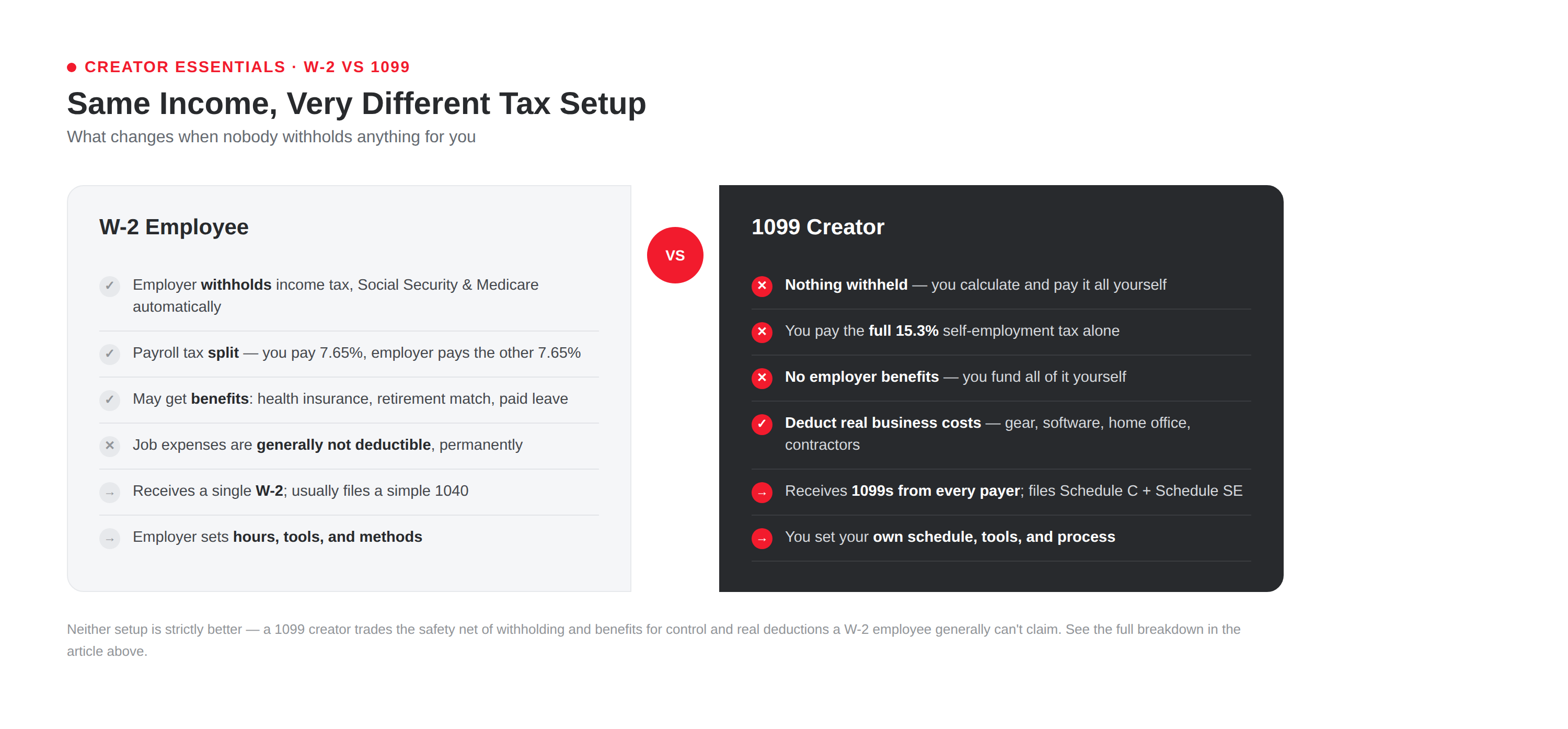
The trade-off isn’t all one direction — a 1099 creator gives up the safety net of withholding and benefits, but gains the ability to deduct real business costs that a W-2 employee generally can’t touch anymore. For the details on what those business structure options can and can’t shield you from, see the pillar guide’s section on sole proprietor vs. LLC vs. S-corp →.
What to Do the Moment You Get Your First 1099
Your first 1099 shows up and it’s easy to either panic or ignore it. Neither is the right move — here’s the short list:
- Check the number against your own records. Compare the amount on the form to what you actually received from that specific payer. Discrepancies happen, and it’s much easier to sort out in January than in an audit later.
- Note what it’s for. A 1099-NEC from a sponsor and a 1099-K from a payment platform can look similar but represent different things — keep track of which form covers which income so you don’t lose track later.
- File it somewhere it won’t get lost. Start (or continue) the recordkeeping habit — a folder per tax year works well. We cover exactly what to save and for how long in the pillar guide’s recordkeeping section →.
- Check whether you’re now over the estimated tax threshold. A first 1099 often means a first year of owing quarterly payments. If you expect to owe $1,000 or more for the year, don’t wait until April to find out.
- Start tracking expenses now, not at tax time. Every 1099 you receive is unreduced income until you subtract your actual costs — and you can’t deduct what you didn’t track.
Multiple 1099s From Multiple Brands: How to Reconcile Them
Once you’re working with more than one or two sponsors, plus AdSense, plus maybe an affiliate program, you’ll end up with a stack of 1099s that don’t perfectly line up — and one real trap worth knowing about before it costs you.
The double-reporting trap: if a brand pays you through PayPal or a similar platform, you can end up with two forms for the same payment — a 1099-NEC from the brand reporting what they paid you, and a 1099-K from the payment platform reporting what passed through their system. Add both together and you’ve just doubled a chunk of your income on paper.
The fix isn’t complicated, but it does take a system:
- Keep one master ledger of actual income received, payment by payment, independent of any tax form. This is your source of truth.
- When your 1099s arrive, match each one against your ledger rather than adding every form together blindly. If two forms clearly cover the same transaction, that payment gets counted once on your return — not twice.
- Report what you actually earned, not the sum of every form you received. The IRS’s own guidance is that you pay tax on real income once, regardless of how many forms happen to report pieces of it.
- Keep a short note explaining any overlap in your records, in case a form total and your reported total don’t match on their face — a two-line explanation is enough to head off confusion later.
This is exactly the kind of thing that’s easy to get right with a running system and easy to get wrong from memory in March. Which brings us to the actual fix.
Keep It Organized Before Tax Time, Not During
Reconciling a handful of 1099s against your own numbers is manageable. Reconciling a year’s worth of AdSense, five sponsors, an affiliate program, and merch sales — after the fact, from memory — is how creators either overpay or miss deductions entirely.
That’s exactly what our bookkeeping service handles: every payment tracked and categorized as it comes in, so by the time your 1099s show up, they’re just confirmation of numbers you already have — not a scramble to reconstruct a year of income.
See Bookkeeping for YouTubers →
Frequently Asked Questions
Can I ask a brand to send me a W-2 instead of a 1099? No — and you wouldn’t want to. A W-2 reflects an employment relationship that doesn’t exist here. Requesting one wouldn’t change your tax situation; it would just be inaccurate.
What if I never receive a 1099 from a sponsor who paid me? You still owe tax on that income. The obligation to report is yours, independent of whether the payer met their own filing requirement. Keep your own records rather than relying on theirs.
Do I need a 1099 in hand before I can file my taxes? No. You can and should file based on your own accurate income records. A missing or late 1099 isn’t a reason to delay filing or to under-report what you actually earned.
More in This Tax Series
This article is for general educational purposes and isn’t personalized tax advice. Tax law changes, and your specific situation matters — talk to a licensed tax professional before making decisions based on anything here.