Quick answer: Creators need to track two kinds of deadlines — one annual tax filing deadline (mid-April) and four quarterly estimated tax payments (mid-April, mid-June, mid-September, and mid-January), required if you expect to owe $1,000 or more for the year. Missing a quarterly payment can trigger a penalty even if you pay your full balance on time in April — the two aren’t the same thing, and that surprises a lot of creators.
The Two Deadlines That Actually Matter
Everything in this article boils down to two categories:
- Your annual filing deadline — generally April 15, when your full tax return for the prior year is due, along with any remaining balance you owe.
- Your quarterly estimated tax payments — four payments spread across the year, prepaying your tax bill in installments instead of settling it all at once.
Most creators know about the April deadline. Far fewer treat the quarterly payments as equally real — but for a self-employed creator with no employer withholding tax on your behalf, the quarterly payments are where the actual risk of penalties lives. For the full picture of why creators owe both income tax and self-employment tax in the first place, see our complete YouTuber tax guide →.
The Full Quarterly Schedule for Tax Year 2026
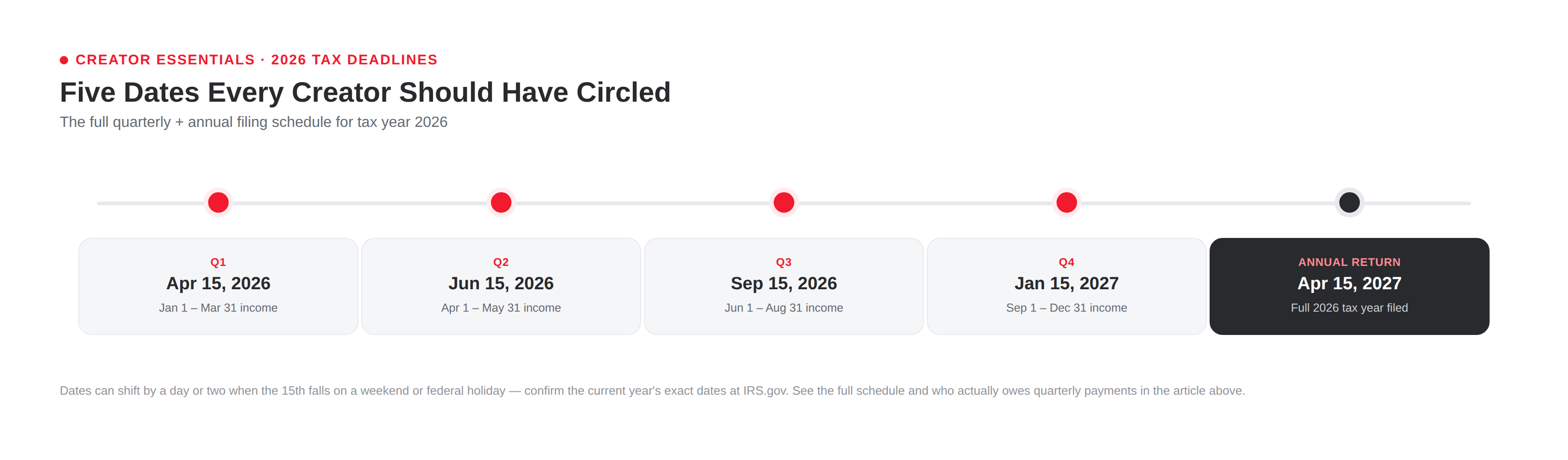
Here’s the complete schedule for tax year 2026 — the year that gets filed by April 2027:
| Payment | Covers income earned | Due date |
|---|---|---|
| Q1 | January 1 – March 31, 2026 | April 15, 2026 |
| Q2 | April 1 – May 31, 2026 | June 15, 2026 |
| Q3 | June 1 – August 31, 2026 | September 15, 2026 |
| Q4 | September 1 – December 31, 2026 | January 15, 2027 |
| Annual return | Full 2026 tax year | April 15, 2027 |
A few notes on the pattern: the periods aren’t quite even three-month chunks (Q2 only covers two months, Q4 covers four) — that’s normal, it’s just how the IRS structured the calendar. Exact dates can shift by a day or two in years when the 15th lands on a weekend or federal holiday, so it’s worth a quick check at IRS.gov each year rather than assuming the same date repeats exactly.
Who Actually Has to Pay Quarterly (the $1,000 Threshold)
Not every creator owes quarterly payments. The rule: if you expect to owe $1,000 or more in tax for the year, after subtracting any withholding, you’re generally required to pay quarterly. For most monetized creators with no other job, that threshold is easy to cross — it corresponds to well under $10,000 of net profit for the year in a lot of cases.
If you clear that threshold, you can avoid a penalty by meeting one of two safe harbors, whichever is smaller:
- Pay at least 90% of your current year’s tax bill, or
- Pay at least 100% of last year’s total tax (or 110% if your prior-year adjusted gross income was above $150,000).
If you have a W-2 job on the side, there’s a simpler option worth knowing: you can increase your withholding at that job instead of making separate quarterly payments. The IRS treats withholding as paid evenly across the year no matter when it’s actually withheld, which sidesteps the quarterly deadlines entirely. We cover this trade-off in more detail in our piece on AdSense income as a side hustle →.
What Happens If You Miss a Quarterly Payment
Here’s the part that catches people off guard: the underpayment penalty is calculated quarter by quarter, not for the year as a whole. Paying your full balance by April 15 settles what you owe — but it does not erase a penalty that already accrued because an earlier quarter went unpaid or underpaid. The IRS calculates this on Form 2210, treating each installment period separately.
Here’s roughly what that looks like: say you underpaid your Q1 payment by $2,000. If you catch up and pay it the following quarter, the penalty on that $2,000 is fairly small — using the current IRS underpayment rate of around 7% annually, that’s roughly $35 for three months late. If that same $2,000 doesn’t get resolved until you file your return the following April — a full year later — the penalty grows to roughly $140. Neither number is catastrophic, and that’s the point: this isn’t something to panic about, but it is real money that compounds the longer a missed quarter sits unresolved, and it’s easy to avoid by simply paying close to on time.
Setting Up Reminders and Automatic Saving So You’re Never Caught Short
The creators who never think about quarterly deadlines usually aren’t the ones with no tax knowledge — they’re the ones with a system. A few that work well:
- Calendar reminders set two weeks out, not the day of — give yourself time to check your numbers and make the payment without a scramble.
- A separate savings account for tax money, funded automatically. Many creators set up an automatic transfer of a percentage of every payout — AdSense deposit, sponsorship payment, whatever comes in — the day it lands, so the money is already set aside before it’s tempting to spend.
- Use the tiered guidance from How Much Do YouTubers Actually Pay in Taxes → to decide what percentage to set aside based on where your income falls.
- Pay through IRS Direct Pay or EFTPS so the payment is scheduled in advance rather than dependent on you remembering to sit down and do it that day.
None of this needs to be complicated. The goal is just making the payment automatic enough that missing one becomes the exception, not something you have to actively remember four times a year.
Does Your State Have Different Deadlines?
Most states with income tax roughly mirror the federal quarterly schedule, but not all of them — and the differences can catch you off guard if you assume they all match.
California is the standout example. Instead of four even 25% payments, California requires a front-loaded 30/40/0/30 schedule: 30% of your annual estimate due in April, 40% in June, 0% in September, and the final 30% in January. Set your California payments up on the standard even-quarters rhythm and you’ll actually be underpaid for Q1 and Q2, even though your total for the year matches — because the state calculates the penalty per installment, the same way the IRS does.
If you live in a state with income tax, don’t assume it follows the federal calendar exactly. A quick check of your state’s tax agency website — or a conversation with a tax pro who knows your state — takes a few minutes and avoids a preventable penalty.
Source: California Franchise Tax Board — Estimated tax payments
Get the Free Printable Creator Tax Calendar
We turned this whole schedule into a one-page, printable calendar — every 2026 deadline in one place, plus a quick reminder of what to set aside each quarter. Pin it above your desk or drop it in your planning doc so the dates are always in front of you.
2026 Creator Tax Deadline Calendar
Every quarterly and annual filing deadline on one printable page — free to download.
Download the Free CalendarWant Someone Watching These Dates With You?
Quarterly payments are simple in theory and easy to let slip in practice, especially with an unpredictable content income schedule. If you’d rather have someone calculate your numbers and flag the dates for you instead of tracking it all solo, that’s exactly what quarterly tax support is for.
Frequently Asked Questions
Do I still owe quarterly taxes if my income is unpredictable month to month? Yes — the requirement is based on your total expected tax for the year, not a steady paycheck. If your income is lumpy, it’s worth recalculating your estimate each quarter rather than paying the exact same amount four times.
What if I miss a quarterly deadline entirely — should I just wait until April? No — pay it as soon as you catch it. The penalty accrues based on how long the underpayment sits, so a late payment made today is cheaper than the same payment made three months from now.
Are quarterly payments only for federal taxes? No — if you live in a state with income tax, you likely owe state quarterly payments too, on a schedule that may or may not match the federal one (see California, above).
More in This Tax Series
This article is for general educational purposes and isn’t personalized tax advice. Deadlines and rates can change, and your specific situation matters — talk to a licensed tax professional before making decisions based on anything here.