There’s no single number that answers this — and any article that gives you one flat percentage is oversimplifying. What you actually pay depends on how much you earn, how many legitimate deductions you claim, and which state you live in. But there is a real, calculable range, and it’s more specific than the vague “20–30%” you’ll see thrown around.
Quick answer: Most YouTubers pay somewhere between 12% and 30%+ of their net profit in federal taxes — a flat 15.3% self-employment tax plus progressive federal income tax (10–37%). The percentage climbs as you earn more: a creator netting around $8,000 a year typically owes about 14% in federal tax, a part-time creator netting $36,000 owes closer to 19%, and a full-time creator netting $105,000 can owe over 26%. State income tax, where it applies, adds more on top of all three.
The Math: Two Taxes, Not One
Every dollar of YouTube profit is hit with two separate federal taxes:
- Self-employment tax — a flat 15.3%. This covers the Social Security and Medicare contributions an employer would normally split with you. It applies starting at just $400 of net profit, with no bracket and no way around it.
- Federal income tax — progressive, 10% to 37%. This is the same bracket system every taxpayer uses, applied to your profit after deductions and your standard deduction.
Because self-employment tax has no floor and doesn’t care about brackets, it’s usually the bigger shock for newer or smaller creators. Income tax is the one that grows as your income does. For the full mechanics of how these two taxes are calculated — including exactly how the 15.3% is applied — see our complete YouTuber tax guide →.
How Much YouTubers Actually Pay, at 3 Income Levels
Here’s what the combined tax bill looks like in practice, at three realistic income levels. Each assumes a single filer taking the standard deduction, with no other income and no state tax included.
| Side-Hustle | Part-Time | Full-Time | |
|---|---|---|---|
| Gross revenue | $10,000 | $50,000 | $150,000 |
| Business expenses | –$2,000 | –$13,700 | –$45,000 |
| Net profit | $8,000 | $36,300 | $105,000 |
| Self-employment tax | $1,130 | $5,129 | $14,836 |
| Federal income tax | $0 | $1,868 | $12,638 |
| Total federal tax | $1,130 | $6,997 | $27,474 |
| Effective rate on net profit | ≈ 14% | ≈ 19% | ≈ 26% |
| Take-home profit | $6,870 | $29,303 | $77,526 |
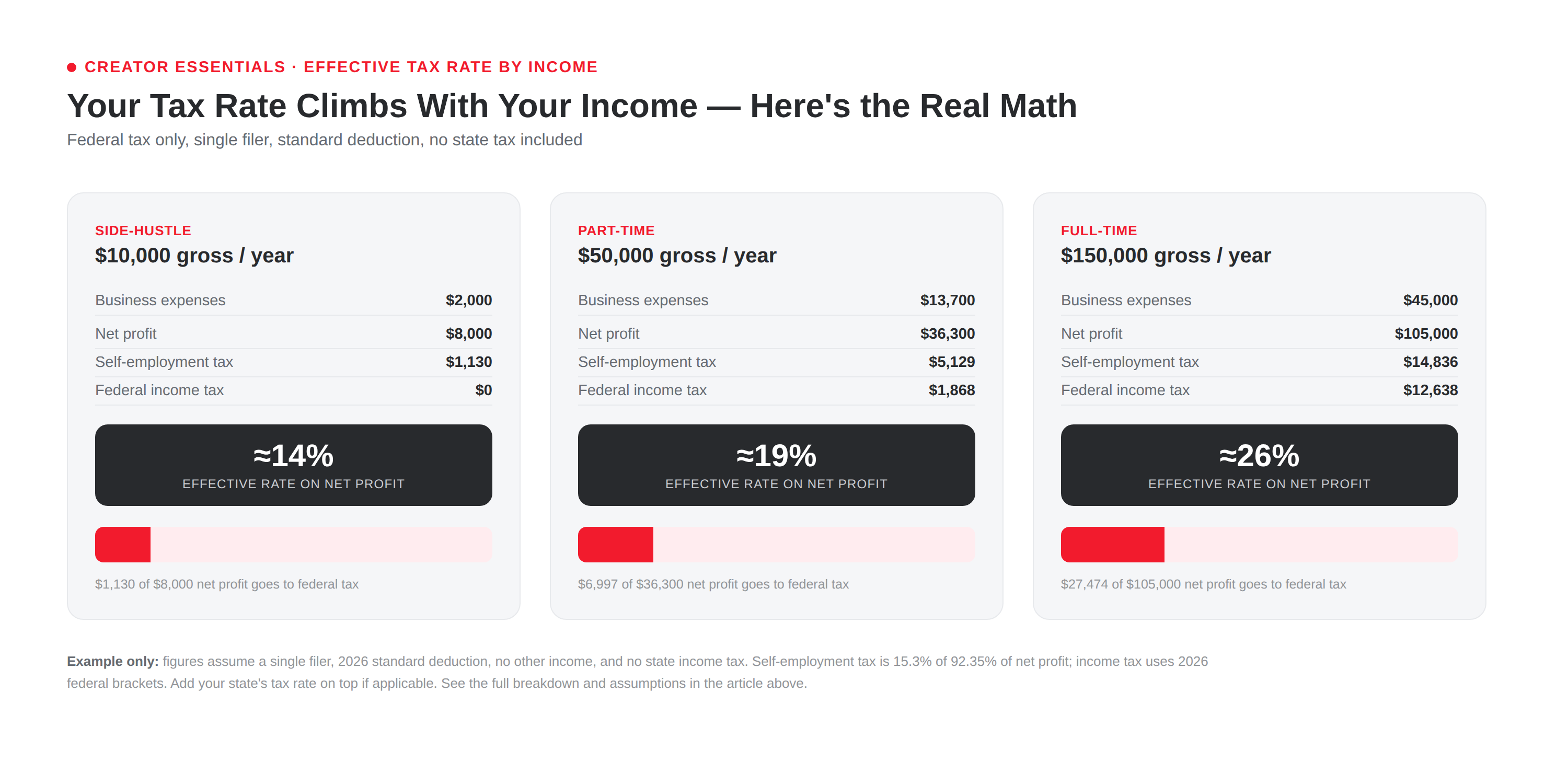
A few things worth noticing in that table:
- At the side-hustle level, income tax is $0. The standard deduction ($16,100 for a single filer in 2026) wipes out the income tax bill entirely — but self-employment tax still applies, because it doesn’t have a deduction like that. This is the single most misunderstood part of creator taxes: even a tiny channel with no income tax liability can still owe over a thousand dollars in SE tax.
- The jump from 19% to 26% isn’t just “more income, more tax.” It’s the progressive brackets doing their job — as taxable income climbs past $50,400 and into the 22% bracket, more of each additional dollar gets taxed at a higher rate.
- These are federal numbers only. Depending on where you live, your actual total could be several points higher — see the state section below.
Why You’re Taxed on Net Profit, Not Gross Revenue
Notice that none of the tax figures above are calculated on the $10,000, $50,000, or $150,000 gross numbers — they’re calculated on what’s left after business expenses. That distinction is the single biggest lever you have over your tax bill.
A creator who earns $50,000 and tracks $13,700 in legitimate deductions is taxed on $36,300. A creator who earns the same $50,000 but doesn’t bother tracking expenses is taxed on the full amount — potentially thousands more in tax on income they didn’t actually keep. Deductions aren’t a loophole; they’re the mechanism that makes sure you’re only taxed on real profit.
This is also why two creators earning identical gross revenue can have noticeably different effective tax rates — it comes down to how well each one tracks equipment, software, contractor pay, home office use, and other costs of running the channel. We cover exactly what qualifies in Every Deduction YouTubers Can Claim →.
Does Your State Add More?
Everything above is federal tax. Depending on where you live, your state may take an additional cut — and the range is wide.
No state income tax at all: Alaska, Florida, Nevada, South Dakota, Tennessee, Texas, Washington, and Wyoming. (New Hampshire also has no tax on wages or business income, though it taxed interest and dividends until that tax was fully repealed starting with the 2025 tax year.) Creators based in these states pay only the federal numbers above.
Higher state income tax: States like California (up to 13.3%), Hawaii (up to 11%), New York (up to 10.9%), New Jersey (up to 10.75%), Oregon (up to 9.9%), and Minnesota (up to 9.85%) apply their own brackets on top of federal tax. Most creators won’t hit the very top bracket in these states, but even the mid-range brackets can add several percentage points to your effective rate.
If you’re weighing a move, or just want to know your real number, factor in your specific state’s bracket — the difference between a no-tax state and a high-tax one can easily be 5–10% of your net profit.
Sources: Tax Foundation — 2026 State Individual Income Tax Rates and Brackets · SoFi — States With No Income Tax in 2026
Quick Rule of Thumb: How Much to Set Aside
You don’t need to run the full calculation every time a payment lands. A simple, slightly conservative set-aside rule covers most creators:
- Under about $15,000 in net profit for the year: set aside 15–20% of each payment.
- Roughly $15,000–$75,000 in net profit: set aside 20–25%.
- $75,000+ in net profit: set aside 25–30%, and lean toward the higher end if you’re not tracking deductions closely.
Add another 3–10% on top of any of these if you live in a state with income tax. Move that money to a separate savings account as it comes in — not your regular checking — so it’s not tempting to spend and it’s ready when your quarterly payment is due. Rounding up is always safer than rounding down; a surplus at tax time is a nice surprise, and a shortfall means a penalty.
For the exact math on when those quarterly payments are due and how to calculate them precisely instead of by rule of thumb, see Quarterly Estimated Taxes for YouTubers →.
Get a Number That’s Actually Yours
Rules of thumb are a starting point, not a substitute for your real numbers — your actual rate depends on your specific deductions, your state, and how your income is structured. If you’d rather know your real percentage than estimate it, that’s exactly what a creator-focused tax pro is for.
Talk to a Creator-Focused Tax Pro →
Frequently Asked Questions
Is the “set aside 30%” rule always right? No — it’s a safe overestimate for most creators, but as the table above shows, a smaller channel might only owe 14%. Setting aside 30% when you only owe 14% just means overpaying yourself into a temporary cash crunch. Use the tier closest to your actual net profit instead.
Do I pay a higher tax rate once I hit a certain income? Your rate rises gradually, not in one jump. Federal income tax is progressive — only the income inside each bracket is taxed at that bracket’s rate, so moving into a higher bracket doesn’t raise the rate on everything you earned.
Does this change if I form an LLC or S-corp? An LLC alone doesn’t change these numbers — it’s still taxed the same as a sole proprietor by default. An S-corp election can lower the self-employment tax portion once you’re consistently profitable, but it adds cost and complexity. That trade-off is covered in our LLC vs. S-Corp guide →.
More in This Tax Series
This article is for general educational purposes and isn’t personalized tax advice. Tax law changes, and your specific situation matters — talk to a licensed tax professional before making decisions based on anything here.