Quick answer: yes, you have to report it — all of it, no matter how small, whether or not you got a 1099, and whether YouTube is your full-time job or something you do on the side. Not reporting it isn’t a gray area, and it isn’t a risk-free way to keep more of what you earned. Back taxes, penalties, and interest start accruing automatically the moment a payment is due, whether or not anyone ever asks you about it — and the IRS has more ways to notice than most creators assume.
This isn’t meant to scare you. Most creators who’ve under-reported did it out of confusion, not intent, and the fix is usually more straightforward than people expect. But it’s worth understanding clearly, because “I didn’t know” and “I didn’t get a form” don’t change what’s owed.
Yes, Always — Even Without a 1099, Even Part-Time, Even “Small”
Every dollar of creator income is taxable the moment you receive it, full stop. That includes:
- AdSense revenue below whatever 1099 threshold applies to your account
- A single sponsorship payment that never triggered a form
- Affiliate commissions trickling in from a handful of programs
- A channel that’s more of a hobby-turned-side-project than a full business
None of those situations create an exception. If you’re earning money from your channel with the intent to make money — which, per the IRS’s own hobby-vs-business test, describes almost every monetized creator — that income belongs on your tax return. We cover why in detail in the complete YouTuber tax guide →, and specifically why a missing 1099 doesn’t mean a pass in our piece on AdSense income →.
How the IRS Actually Catches It
A lot of creators assume that without a 1099, their income is essentially invisible. That’s not how it works in practice.
Automated matching. The IRS runs an Automated Underreporter (AUR) program that cross-checks every 1099, W-2, and similar form filed by businesses and platforms against what you reported on your return. When a payer’s form shows income that doesn’t appear on your return, it generates a mismatch — and mismatches generate a CP2000 notice, an automated letter proposing an adjustment to your return based on the discrepancy. This system doesn’t require a human to suspect you of anything; it runs on nearly everyone, automatically, every year.
More forms than you might expect. Between AdSense, sponsors who do issue 1099s, and payment platforms that issue their own 1099-Ks for processing your payments, there are more paper trails pointing back to your income than the phrase “I never got a form” accounts for. You don’t need to receive a form yourself for a payer’s copy to already be sitting in the IRS’s system.
Bank deposits, in an audit. If a return is ever selected for audit — for reasons that may have nothing to do with unreported income at all — deposit patterns are one of the first things examined. Regular deposits from payment platforms, sponsors, or ad networks that don’t reconcile to reported income are exactly the kind of pattern that turns a routine audit into a bigger conversation.
None of this requires bad luck or a targeted investigation. It’s largely automatic, and it runs quietly in the background regardless of how small your channel is.
Source: IRS — Topic no. 652, Notice of underreported income – CP2000
Real Consequences: Back Taxes, Penalties, Interest, and Audit Risk
The exposure depends on your specific situation, but here’s what’s actually on the table:
If you filed a return but left income off it (the most common situation for creators — you filed, you just missed a sponsor payment or some AdSense revenue): you’ll owe the additional tax, plus a failure-to-pay penalty of 0.5% per month on the unpaid amount (up to 25%), plus interest, which compounds daily and is currently running around 7% annually. Depending on the circumstances, an accuracy-related penalty of up to 20% of the underpayment can also apply if the IRS determines the omission was due to negligence or a substantial understatement.
If you never filed a return at all for a year you had income: the failure-to-file penalty applies on top of everything above — 5% per month of the unpaid tax, up to 25%, with a minimum penalty of $525 (or 100% of the tax owed, if less) once you’re more than 60 days late. Unfiled returns also don’t start the normal statute of limitations clock, so the exposure doesn’t quietly expire the way it would if you’d filed.
How long the IRS can look back: generally three years from when you filed. That extends to six years if you understated your gross income by more than 25%, and there’s no time limit at all for a year you never filed or for cases involving fraud.
Here’s what that actually looks like in dollars, for a straightforward case — a creator who filed on time but left about $3,000 of tax owed off the return, and it sits unresolved:
| Time unresolved | Interest accrued | Failure-to-pay penalty | Total owed |
|---|---|---|---|
| At filing | $0 | $0 | $3,000 |
| 6 months | ~$107 | ~$90 | ~$3,197 |
| 12 months | ~$217 | ~$180 | ~$3,397 |
| 24 months | ~$449 | ~$360 | ~$3,809 |
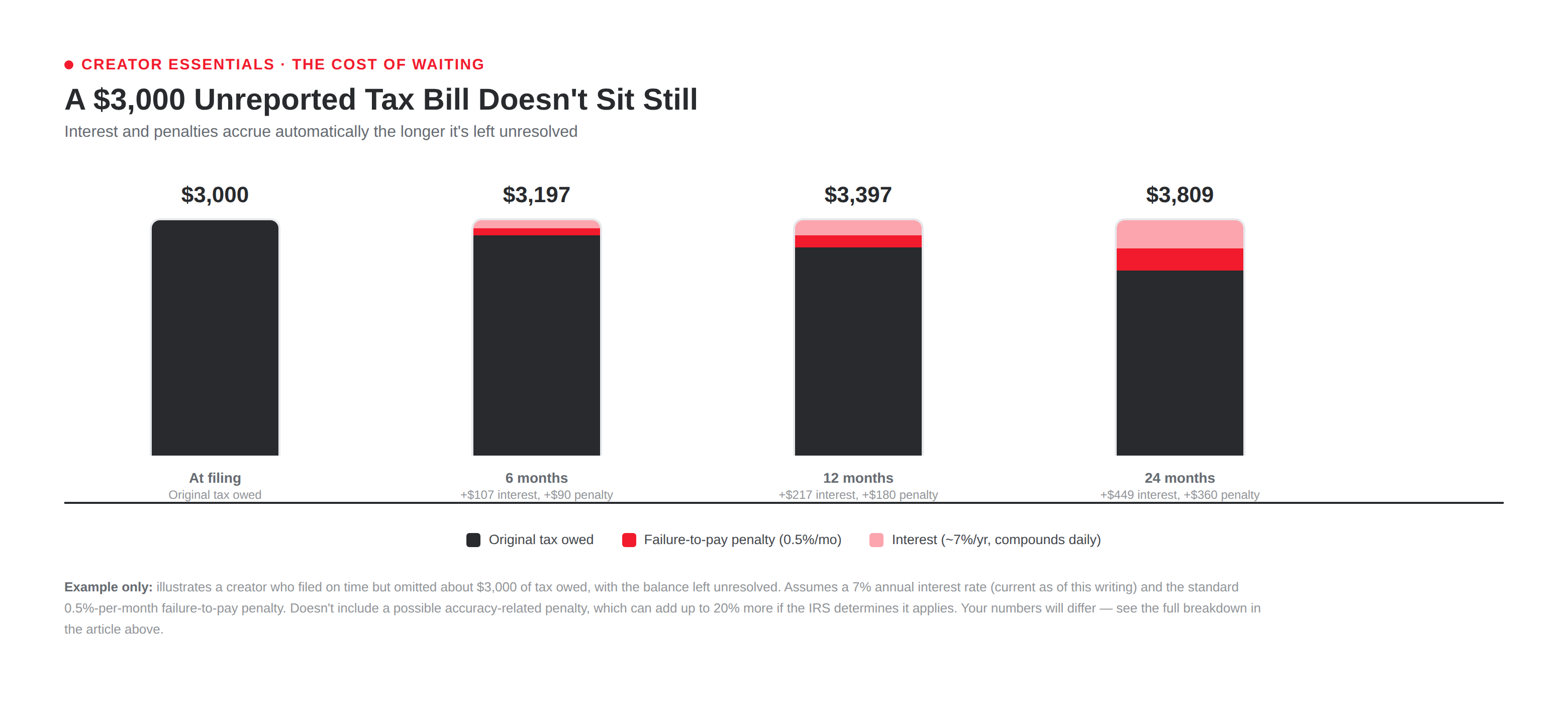
That’s the ordinary cost of time passing — not a worst-case scenario, just interest and a standard penalty doing what they do. It only grows from there the longer it sits, and it doesn’t reset or forgive itself. The number that matters most here isn’t any single penalty — it’s that every one of these figures is smaller the sooner you deal with it.
Sources: IRS — Failure-to-Pay Penalty · IRS — Failure-to-File Penalty · IRS — Quarterly Interest Rates
The “I Didn’t Get a 1099 So I Don’t Owe” Myth, Debunked
This is the single most common misunderstanding we see, and it’s worth saying plainly one more time: a 1099 is paperwork, not permission. It tells the IRS (and you) what a payer reported — it doesn’t create your tax obligation, and its absence doesn’t remove one. Whether the relevant threshold is $600 or $2,000, whether a brand forgets to send the form, or whether a platform simply doesn’t cross the reporting line, none of that changes what you owe. We break this down further in our piece on the difference between 1099 and W-2 income →, but the short version is: your responsibility to report is entirely independent of whether someone else met theirs.
What to Do If You’ve Already Under-Reported in a Prior Year
If you’re reading this and realizing a past year wasn’t fully accurate, the fix is more manageable than it probably feels right now: file an amended return, Form 1040-X, correcting the income for that year and paying whatever additional tax is owed.
A few things worth knowing:
- Fixing it yourself, before the IRS raises it, is generally the better path. It stops the clock on further complications, shows good-faith compliance, and puts you back in control of the timeline instead of reacting to a notice.
- You can amend more than one year at once if more than one prior return needs correcting — each year gets its own 1040-X.
- The penalties involved are almost always lower than people fear, especially compared to letting the IRS find it first through a CP2000 notice, at which point you’re responding to their number instead of presenting your own.
- This is a very normal thing to fix. Creators who started monetizing without realizing the tax implications, or who had a year with scattered records, are the rule here, not the exception. It’s a correction, not a confession.
How Working With a Pro Actually Helps
No one — including us — can promise an amended return won’t be reviewed, or that a filed return will never be selected for anything. What a tax professional can do is make sure the numbers going in are accurate the first time, catch income sources and deductions a DIY filer commonly misses, and represent you directly if the IRS does have a question, instead of you sorting through a notice alone. The value isn’t a guarantee — it’s fewer mistakes going in, and someone in your corner if something comes up.
Not Sure If a Prior Year Is Clean? Let’s Just Check
If something in this article made you pause and think about a specific year, that’s worth a quick, low-key conversation — not a spiral. Most of the time, sorting out whether there’s actually an issue takes less time than people expect, and knowing where you stand beats wondering.
Talk to a Creator-Focused Tax Pro →
No judgment, no scare tactics — just a straight answer about where you stand.
Frequently Asked Questions
Will I go to jail for not reporting YouTube income? For the overwhelming majority of creators, no. Criminal tax cases are reserved for clear, willful, and usually large-scale evasion — not for a creator who missed reporting a sponsorship or misunderstood a threshold. The realistic consequences for most people are back taxes, penalties, and interest, not criminal exposure.
What if I genuinely didn’t know I owed taxes on this? That’s an extremely common starting point, and it doesn’t change what’s owed, but it does mean the fix is usually straightforward — amend the return, pay what’s due, and put a system in place going forward so it doesn’t happen again.
Does the IRS care about small amounts, like a few hundred dollars? The automated matching systems don’t distinguish by size — a mismatch generates a notice whether it’s for $200 or $20,000. That said, the dollar consequences scale with the amount, so a small omission usually means a small, manageable correction.
More in This Tax Series
This article is for general educational purposes and isn’t personalized tax or legal advice. Every situation is different — talk to a licensed tax professional about your specific circumstances before making decisions based on anything here.