Quick answer: Yes. Every dollar Google pays into your account through AdSense is taxable income the moment it lands — whether it’s $40 or $40,000, and whether or not Google ever sends you a tax form. AdSense income is self-employment income, taxed at your regular income tax rate plus a 15.3% self-employment tax. There’s no minimum amount that’s exempt, and no such thing as “too small to report.”
That answer surprises people because AdSense doesn’t feel like a paycheck — there’s no employer, no offer letter, no HR department. But the IRS doesn’t care how the money showed up in your account. It cares whether you earned it by doing something. And running a channel, growing an audience, and placing ads against your content is doing something.
Why AdSense Income Is Taxable — It’s Not a Gift
AdSense pays you because your content generated ad impressions and clicks, and Google shares a cut of that ad revenue with you. That’s compensation for an ongoing activity — the same category as freelance income, consulting fees, or any other self-employment earnings. It’s not a prize, a gift, or found money, and none of those categories would apply even if it felt that way.
This matters because it determines how the income is taxed. If AdSense earnings were treated as a hobby payout, you’d owe tax on the full amount with no ability to deduct expenses. Because it’s business income, you’re taxed only on your net profit — revenue minus your legitimate costs of producing the content — and you report it the same way any self-employed person reports business income: on Schedule C, with self-employment tax calculated on Schedule SE.
For the full breakdown of why creator income counts as self-employment and not a hobby, see our complete YouTuber tax guide →.
The $600 1099 Threshold — And Why You Owe Tax Even Under It
Google’s own AdSense help documentation says it issues a Form 1099-NEC to US publishers who receive $600 or more in service payments during the year (royalty payments, a separate category, trigger a 1099-MISC at just $10). Worth knowing: the general federal reporting threshold for 1099-NEC forms rose from $600 to $2,000 starting with the 2026 tax year under recent tax legislation. Google hadn’t updated its published guidance to reflect that as of when we wrote this — so don’t assume either number applies to your account without checking the actual tax documents in your AdSense dashboard each January.
Here’s the part that matters more than the exact number: that threshold only controls when Google is required to send you paperwork. It has nothing to do with when you owe tax. Whether the cutoff is $600 or $2,000, a creator who earns $450 or $1,500 in AdSense revenue in a year and never receives a 1099 still owes tax on every dollar of it. Under US tax law, income is taxable unless a specific rule says otherwise — and “my payor didn’t send a form” isn’t one of those rules.
Source: Google AdSense Help — 1099-MISC and 1099-NEC thresholds
Side Income vs. Your Only Income: The Rate Isn’t the Same
This is the part almost no one explains, and it changes your actual number more than almost anything else: the same AdSense profit can be taxed at a very different rate depending on whether it’s your only income or stacked on top of a job.
Here’s why. Everyone gets one standard deduction per year ($16,100 for a single filer in 2026) and starts climbing the tax brackets from $0. If AdSense is your only income, your net profit gets the benefit of that deduction and the lowest brackets first. If you already have a W-2 job, your wages have already used up that deduction and filled in the lower brackets — so your AdSense profit stacks on top and gets taxed starting at whatever bracket your day job left off in.
| AdSense as your only income | AdSense as side income (on top of a $80,000 salary) | |
|---|---|---|
| Net AdSense profit | $7,200 | $7,200 |
| Self-employment tax | $1,017 | $1,017 |
| Federal income tax on that profit | $0 (absorbed by standard deduction) | $1,472 (taxed at your 22% marginal rate) |
| Total tax on the $7,200 | $1,017 | $2,489 |
| Effective rate on that profit | ≈ 14% | ≈ 35% |
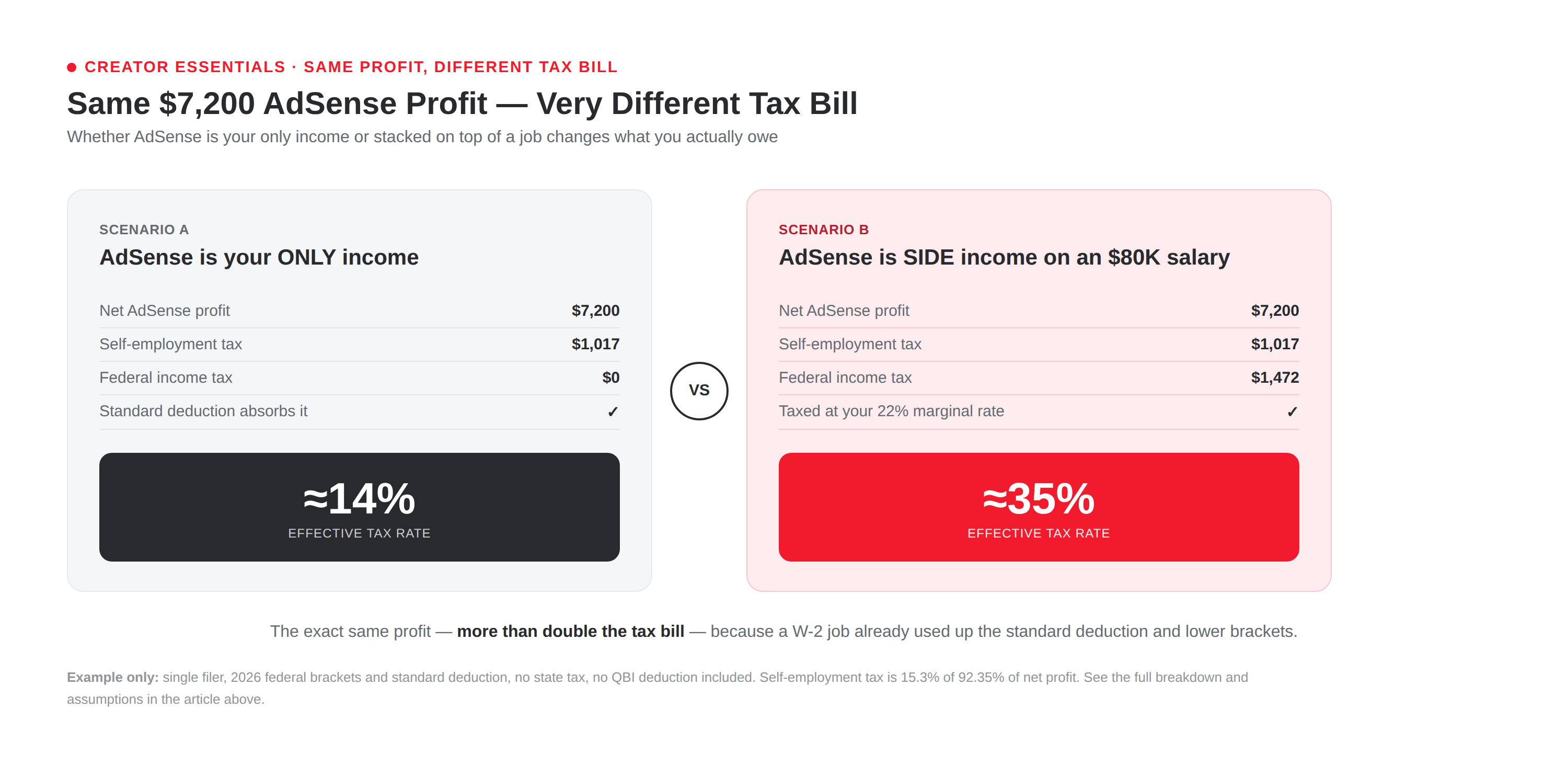
Same $7,200. More than double the tax bill, purely because of what else is on your return. If AdSense is supplementing a job, budget for the higher number — assuming your side income will be taxed like your only income is one of the most common ways creators underestimate what they’ll owe.
This also changes how you should handle payment. If you have a W-2 job, you can often avoid separate quarterly filings altogether by increasing your withholding at that job (submit a new W-4) to cover the extra tax — the IRS treats withholding as paid evenly across the year no matter when it’s actually withheld, which is more forgiving than the quarterly estimated payment schedule. If AdSense is your only income, there’s no withholding to lean on, and quarterly estimated payments become mandatory once you expect to owe $1,000 or more for the year. We walk through those deadlines and safe harbor rules in Quarterly Estimated Taxes for YouTubers →.
Submitting Your Tax Info to Google (Walkthrough)
Separate from year-end 1099s, Google requires every monetizing creator — regardless of how much you earn — to submit tax information before they’ll release payments. Skip this step and Google can withhold at the maximum backup rate: 24% of your total worldwide earnings for creators who don’t provide valid tax info by the December cutoff. This isn’t optional paperwork; it’s what determines whether you get paid in full or get a chunk held back automatically.
To submit it:
- Sign in to your AdSense account.
- Go to Payments → Payments info.
- Click Manage settings.
- Under “Payments profile,” find United States tax info (or your country’s equivalent) and select Manage tax info.
- Follow the prompts to select your filing status — individual/sole proprietor, single-member LLC, or partnership — and submit your W-9.
A few things worth knowing: your legal address has to match across every field or your year-end forms won’t generate correctly, and Google’s tax forms expire every three years and need to be resubmitted even if nothing about your situation has changed. Set yourself a reminder — a lapsed form is exactly the kind of thing that quietly triggers backup withholding on a channel that’s otherwise in good standing.
Sources: Google AdSense Help — Submit your US tax info · YouTube Help — US tax requirements for YouTube earnings
How to Actually Calculate What You Owe on AdSense
If AdSense is one of several income streams — sponsorships, affiliate, merch — you don’t calculate its tax in isolation. The IRS taxes your total net self-employment profit for the year, all income sources combined minus all business expenses combined, as one number on Schedule C. There’s no separate “AdSense tax.”
But you can absolutely isolate your AdSense numbers for your own planning:
- Pull your finalized payments. In AdSense, go to Payments → Transactions and filter to finalized payments for the calendar year. Use what Google actually paid you, not what your Reports tab shows as earned — taxes are based on cash received, and the two numbers won’t always match at year-end if a payment straddles December and January.
- Subtract the expenses tied to producing that content — gear, editing software, a share of your home office, contractor pay, and anything else that’s a legitimate cost of running the channel.
- What’s left is your net profit. Multiply it by 92.35%, then by 15.3%, to get your self-employment tax.
- Add income tax on top, calculated on that profit combined with any other income you have, after your standard deduction — which is exactly why the side-income-vs-only-income distinction above matters so much.
- Want a fast estimate instead of the full math? Use the income-tier ranges in How Much Do YouTubers Actually Pay in Taxes → to ballpark your rate before you calculate the exact number.
The Common Mistake: Waiting for a 1099 That Never Comes
The single most frequent mistake we see: a creator earns a modest amount from AdSense, doesn’t hit whatever the current 1099 threshold is, never receives paperwork from Google, and quietly assumes that means it doesn’t need to be reported. It’s an understandable assumption — and it’s wrong, and it’s also risky. The IRS doesn’t need a 1099 to know income exists; deposits, patterns, and mismatches between your lifestyle and your reported income can all surface in ways that create problems well after the fact, plus interest and penalties on top of the original tax.
The fix is simple: don’t wait on Google’s paperwork to decide what you report. Keep your own running record of every AdSense payment as it lands, and report the full total regardless of whether a 1099 ever shows up.
Get Your AdSense (and Everything Else) Tracked Properly
The hardest part of all this usually isn’t the tax rate — it’s knowing your real numbers when it’s time to file. If your AdSense deposits, sponsorship payments, and expenses are scattered across a personal bank account and a shoebox of receipts, even a simple calculation turns into a guessing game.
That’s what our bookkeeping service is for — keeping your AdSense income and every other revenue stream cleanly tracked all year, so tax time is a formality instead of a scramble.
See Bookkeeping for YouTubers →
Frequently Asked Questions
Do I owe taxes on AdSense income under $600? Yes. $600 (or $2,000, depending on which threshold applies to your account) is only the point at which Google is required to send you a 1099 — it’s not a minimum for owing tax. All AdSense income is taxable from the first dollar.
Does Google withhold taxes from my AdSense payments automatically? Only if you haven’t submitted valid tax information, in which case backup withholding of up to 24% can apply. Creators who’ve submitted a current W-9 generally have nothing withheld and are responsible for paying their own tax through quarterly estimates or day-job withholding.
Is AdSense income treated differently than sponsorship or merch income? No — for a monetized creator, all of it is self-employment income reported together on the same Schedule C. AdSense isn’t taxed by a different set of rules; it’s just one more revenue line.
More in This Tax Series
This article is for general educational purposes and isn’t personalized tax advice. Tax law changes, and your specific situation matters — talk to a licensed tax professional before making decisions based on anything here.